What is a KOL in pharma? Your ultimate guide to key opinion leader influence and insight in healthcare in 2026
What is a KOL in pharma?
A key opinion leader (KOL) in pharma is a medical expert who, because of their expertise and prominence in a particular therapy area, influences other healthcare professionals in their management or treatment in that therapy area.
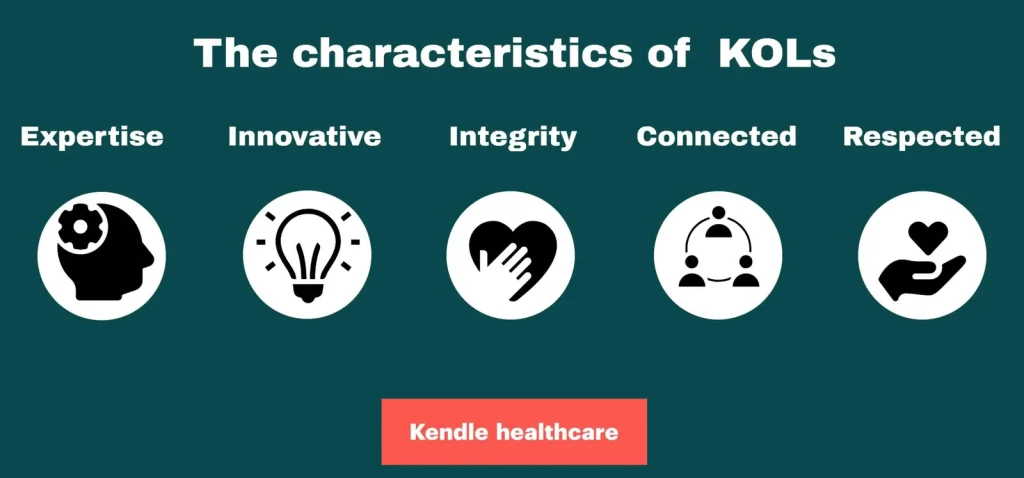
A KOL in pharma is likely to have the following characteristics:
- Expertise – they are knowledgeable about a topic.
- Innovative – they are open to new ideas and trying to push knowledge forward.
- Integrity – they are intellectually honest.
- Connected – they interact with many other people and have the platform to be known.
- Respected – others respect them because of the above.
What is opinion leadership?
The concept of opinion leadership and key opinion leaders (KOLs) was born out of the work of agricultural sociologists in the 1940s.
Researchers such as Bryce Ryan and Neal Gross (1943) were interested in understanding why new innovations in corn seed, which were obviously beneficial, were not immediately taken up by farmers in Iowa.
These researchers discovered that the decision-making process was less rational and more social than people had supposed; most of the farmers only adopted the new, better, hybrid corn seed once an influential member of their social network did so.
These influential people were the keys that led to the changing opinion and behaviour of others.
Studies throughout the latter half of the 20th Century confirmed that individuals in a network do not respond to the adoption of new ideas rationally:

How does a KOL influence their peers in pharma?

- KOL expertise – the KOL in pharma makes objective judgements not based on social norms.
- Respected – non-KOL HCPs look to the KOL for the lead when it comes to new ideas.
- An innovation – a new idea or product is introduced.
- KOL judgement – the KOL engages with data and theory relevant to the innovation.
- KOL decision – The KOL decides to adopt the innovation.
- Narrative – the KOL creates an easily understandable narrative as to why they have adopted.
- HCP understanding – non-KOL HCPs understand the narrative and trust its source.
- HCP adoption – the innovation is adopted by HCPs influenced by the KOL in pharma.
Which brings us nicely onto our next question…
Do pharma and other healthcare companies need to engage with KOLs?
You absolutely need to engage with KOLs.
As a life science company, you’ll know that the quality of your product, the benefit it promises for healthcare professionals and patients, and the data that supports it isn’t enough to lead to uptake.
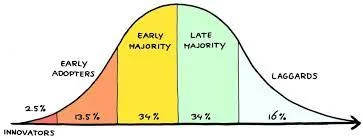
In the famous diffusion of innovations graph, early adopters, or key opinion leaders, drive the acceptance of an innovation.
The first reason why you need to engage with KOLs in pharma and other life-science industries, is that they can spread news of your product to other healthcare professionals and their social position will mean that this product message is likely to be accepted.
Without the help of KOLs, your beneficial product may be ignored, in the same way that for almost fifty years the British Navy ignored citrus juice as a preventative measure for scurvy.
The second reason why you must engage with KOLs is because of the insight the KOL can provide you.
As researchers such Eveland (1977) have shown, the KOL also acts as a change-agent, adapting an idea or the message that leads to its adoption as it spreads.
KOLs are experts in their field, and if you aren’t working in partnership with them, then your product and data and messaging about your product won’t be optimum.
Examples of the information and expertise a KOL in pharma can provide include:
- Running clinical trials.
- Interpreting trial data.
- Illuminating current and ideal clinical practice.
- Advising on product messaging and placement.
- Advice about political issues around healthcare.
- Presenting product data.
This is why whether you are medical affairs, marketing, sales, or research and development, you need to be engaging with KOLs.
Without KOL collaboration you won’t know exactly how your products should be used, which patients they will help the most, and non-expert HCPs won’t be aware of your products.
If you’re not engaging, you won’t be successful.
Why do pharma KOLs choose to engage with industry?
When working with key opinion leaders, it is important to understand why they may choose to work with you. Often understanding why a pharma KOL may want to work with you will be the difference between your invitation to an activity being accepted or rejected.
KOLs are of course individuals with different motivations and viewpoints but below is a list of reasons why a KOL in pharma chooses to work with industry.
Reasons why KOLs choose to work with pharma companies
Any of these reasons, on their own or in combination, will be the motivations behind a KOL in pharma deciding to work with industry:
- Money – KOLs deserve to be compensated for any work they carry out for a company, but money is rarely the an important motivator for a KOL choosing to engage with a company.
- Research – Many KOLs wish to carry out exciting research and often industry is a major source of funding.
- Professional development – KOLs can develop or hone skills, such as presenting scientific date, through industry activities.
- Scientific discussion – Activities such as advisory boards are often an opportunity for interesting academic discussion.
- Latest research – Working with industry is often a way to access the latest scientific research and shape the future of a therapy area.
- Altruism – By engaging with pharma, KOLs can sometimes deliver educational resources or other schemes they see as beneficial to their community.
What are the different types of KOL in pharma?
Often, we find ourselves identifying very specific types of KOLs for clients which are particular to the client’s contexts and needs. There is little value in discussing these context-specific categories of KOLs here as they only have value for those particular companies.
However, it is also often beneficial to categorize KOLs to help with decisions about who to work with and why. Some general categories that can be used include:
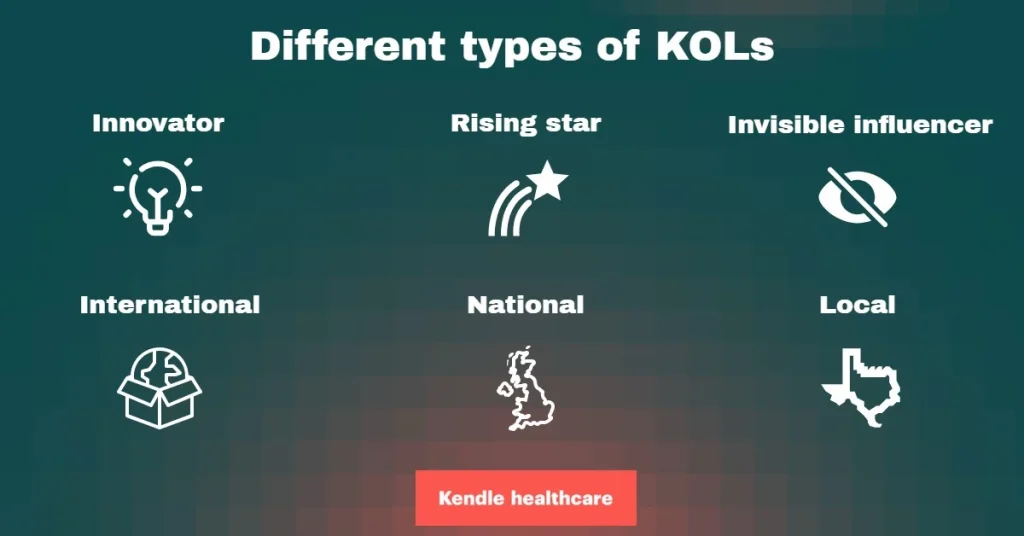
Different types of KOL in pharma.
Innovators
- Collaborate with a wide-range of different experts.
- Not necessarily particularly influential.
- Almost exclusively make up their minds about the science and are not influenced by others.
- Knowledgeable about the latest science and research, particularly about new and unusual
ideas. - Excellent for their insight into the future of an area and to test new and exciting ideas.
International KOLs in pharma
- Highly published, involved with the major international societies and journals.
- Influence international and national KOLs and, indirectly, everyone else.
- Make up their own minds about the science and influenced by other international KOLs.
- Have knowledge of the latest research and/or best practice.
- Essential for clinical trials and endorsement.
National KOLs in pharma
- Some scientific research, involved with the major national societies, and guidelines groups.
- Influence national and local KOLs.
- Influenced by international KOLs and other national KOLs.
- Have knowledge of the latest research and/or best practice.
- Excellent for knowledge of national best practice and clinical need, and national influence.
Local KOLs in pharma
- May have published a few articles, often lecturers at medical schools.
- Influence local non-KOLs.
- Influenced by international and national KOLs.
- Have knowledge of the accepted scientific view.
- Excellent for local educational presentations and decisions and knowledge about local
guidelines.
Rising stars
- A few published but highly regarded articles, occasional executive committee membership of national societies.
- May influence non-KOL local HCPs.
- Influenced by international and national KOLs.
- Have knowledge of the latest scientific research and clinical best practice.
- Good to establish relationships with them before they become highly influential.
Invisible influencers
- Neither their amount of scientific research nor their positions of influence reflect their influence in a therapy area.
- Often the conduit for new ideas and ways of thinking to international and national KOLs.
- Influenced by international KOLs.
- Knowledge of the latest scientific research and future directions of a therapy area.
- Excellent for message shaping and insight.
What is a digital opinion leader in pharma?
A digital opinion leader (DOL) in healthcare is someone with a high profile online, generally through Twitter, YouTube, podcasts or blogging.
In general, we would say that there are two possible types of digital opinion leaders.
The first, is a key opinion leader who happens to also have a digital presence; this might be someone who publishes widely, is president of a national society, and happens to also post to Twitter.
The second type of digital opinion leader is followed online but wouldn’t be considered a key opinion leader offline; they would be someone who doesn’t publish and doesn’t have any other traditional markings of key opinion leadership, but is active online, has followers, and disseminates medical best practice.
While you can identify the second type of digital opinion leader through analysis of social media only, for the first type of opinion leader you would need to conduct a traditional identification and mapping of KOLs in pharma, and then analyse the social media use of those key opinion leaders (KOLs).
Does this matter?
Well, yes. Because the type of digital opinion leader that can be analysed through a digital opinion leader listing only isn’t really an opinion leader at all.
Firstly, they are not necessarily experts and therefore there is no scientific insight that can be gained from collaborating with them, though they may have insight into how customers are thinking about a product.
Secondly, while theoretically, they can disseminate information, and sway opinions, I have found from talking to countless medical professionals about how they use the internet, that very few pay attention to those online who don’t have more traditional expertise and credibility.
In other words, only the first type of digital opinion leader, the ones who are also traditional KOLs, have significant influence or scientific insight.
Recent Posts
- Opinion Leadership Demystified: Transformational Knowledge For Every Industry in 2026 June 15, 2026
- Mastering Open and Honest KOL Communication: The Cornerstone of Effective KOL Engagement June 15, 2026
- The Ultimate KOL Networking Guide: Mastering KOL Engagement at Conferences (2026) June 15, 2026
- Transform KOL Relationships and Engagement: Embracing the KOL Point of View in 2026 January 27, 2025
- What is a KOL in pharma? Your ultimate guide to key opinion leader influence and insight in healthcare in 2026 January 26, 2025